Why do bumper cars have an antenna?
Date: 2026-06-08
Comprehensive Overview of the Bumper Car Conductive Pole (Antenna): Principles, Construction, and Function
I. Physical Structure
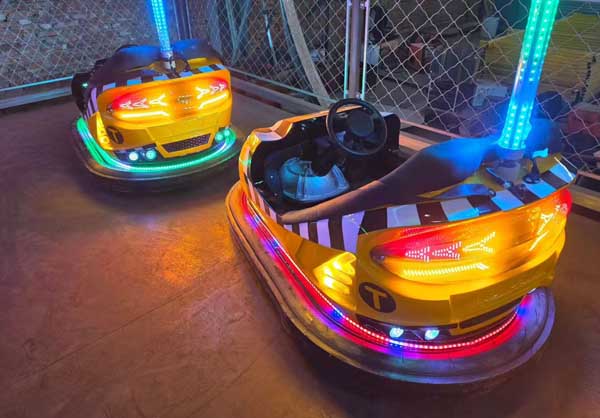
The "antenna" we see is formally known as the current collector or conductive pole assembly. It consists of three main sections:
Base Mount: Bolted to the rear frame of the bumper car, it features a universal swivel joint allowing for slight movement in all directions; this ensures the pole can tilt without snapping or breaking when the car collides or leans.
Main Support Pole: Made of hollow fiberglass or high-strength steel tubing, it is lightweight yet tough. It automatically springs back to an upright position after bending under pressure, thanks to an internal compression spring that constantly pushes the top contact upward, ensuring it remains firmly pressed against the overhead power grid.
Top Conductive Head (Carbon Brush): Composed of a wear-resistant graphite carbon block and a copper base, this is the actual conductive component. Graphite offers excellent conductivity and wear resistance, preventing sparks or rapid degradation during friction against the metal grid. The copper base connects to a thick internal copper wire that leads directly to the vehicle's main control switch and drive motor.
 II. Power Supply System Configuration (Two-Pole Circuit for Overhead-Grid Bumper Cars)
Overhead-grid bumper cars utilize a dual-pole power supply system: the positive pole is located in the ceiling, and the negative pole is on the floor.
Upper Electrode: Overhead Metal Grid
The venue's ceiling is covered with a grid of galvanized steel plates connected to form a single power supply pole, energized with the positive terminal of the power source (typically a safe, low voltage such as 48V).
Lower Electrode:Conductive Floor
The floor consists of conductive steel plates separated by insulating rubber strips. These plates are connected to the negative terminal of the power source, with the rubber insulation in the gaps preventing a short circuit between the positive and negative poles. Complete Electrical Circuit
Overhead grid (positive) → Top carbon brush → Internal copper wire in the conductive pole → Main power switch inside the bumper car → Foot-operated accelerator controller → DC drive motor → Metal chassis and conductive rubber wheels → Ground conductive steel plate (negative); this forms a closed circuit, powering the motor to drive the wheels forward.
III. Design Purpose of the Spring and Universal Joint Mechanism (Optimized for Collisions)
Maintains power during tilting from collisions
When two cars collide violently, the body may tilt or lift sharply; the universal joint allows the conductive pole to sway with the body's movement. The internal spring keeps the carbon brush pressed firmly against the overhead grid—even at a 45-degree tilt—ensuring the car does not lose power.
Shock absorption and fracture prevention
If the pole bends due to external impact, the spring absorbs the force and returns to its original position once the force is removed, making it less prone to breaking compared to a rigid pole.
Adapts to height variations in the venue
There may be slight height differences in the overhead grid installation; the spring automatically compensates for these variations through expansion and contraction, maintaining constant, tight contact.
IV. Causes of sparking
During movement or the jolts of a collision, the carbon brush may briefly lose contact with the overhead metal grid. As the circuit momentarily breaks and reconnects, the air undergoes dielectric breakdown, creating small electric sparks—a normal physical phenomenon. Graphite carbon blocks wear down over time due to friction and simply require periodic replacement.
V. Comparison of three types of bumper cars and why some lack an antenna
With conductive pole (antenna) = Overhead-grid bumper cars: Draw power from the ceiling grid; low cost, unlimited runtime; commonly used in large indoor amusement park venues.
No antenna, dual-layer conductive steel floor = Floor-grid bumper cars: Both positive and negative poles are integrated into the floor; wheels consist of a mix of insulating and conductive types; draws power directly from the floor, eliminating the need for an overhead grid.
No antenna, suitable for standard plastic flooring = Battery-powered bumper cars: Feature built-in lead-acid or lithium batteries; self-contained power source; not restricted by venue power supply; commonly used in open-air plazas and fairs.
VI. Safety Design Details
The power supply system primarily operates on low-voltage DC (36V/48V)—levels far below the threshold for dangerous electric shock—ensuring safety even in the event of accidental contact with the conductive rods or the floor; additionally, the overhead power grid is enclosed within a protective insulating frame.